Arriving at a shared kitchen with groceries in hand is a poor time to discover that your access card opens only your cabin. Before heading to a campsite facility, take a moment to check what your card is for, when it works, and whether the space has any separate rules. A quick check can save a walk back to reception and help you plan your visit around the facilities you can actually use.
Start with the information you were given
Access arrangements vary between campsites and other holiday accommodation. A card might open a cabin, a sanitary building, a laundry room, or several guest areas. Some facilities may require no card at all. The card’s appearance alone rarely tells you which applies, so start with your booking details, check-in information, or any facility guide supplied with your stay.
Look for the facility’s name, its location, opening times, and any mention of access for guests or visitors. Also check whether access begins at check-in and ends at check-out. If the written information is unclear, ask staff which spaces your card covers. That is more reliable than assuming every locked door works the same way.
Before leaving your accommodation, check:
- Which building or entrance you need and whether it uses a card reader.
- Whether the facility is included with your stay or needs a separate booking or payment.
- Any posted hours, seasonal arrangements, or limits on use.
- Whether everyone in your group needs a card or can enter together.
Check the card without forcing the door
Inspect the card for obvious damage such as a crack, a bent edge, or a worn surface. If it came in a sleeve with printed instructions, read those before trying it. Keep it away from keys or other items while using the reader so you can present it clearly.
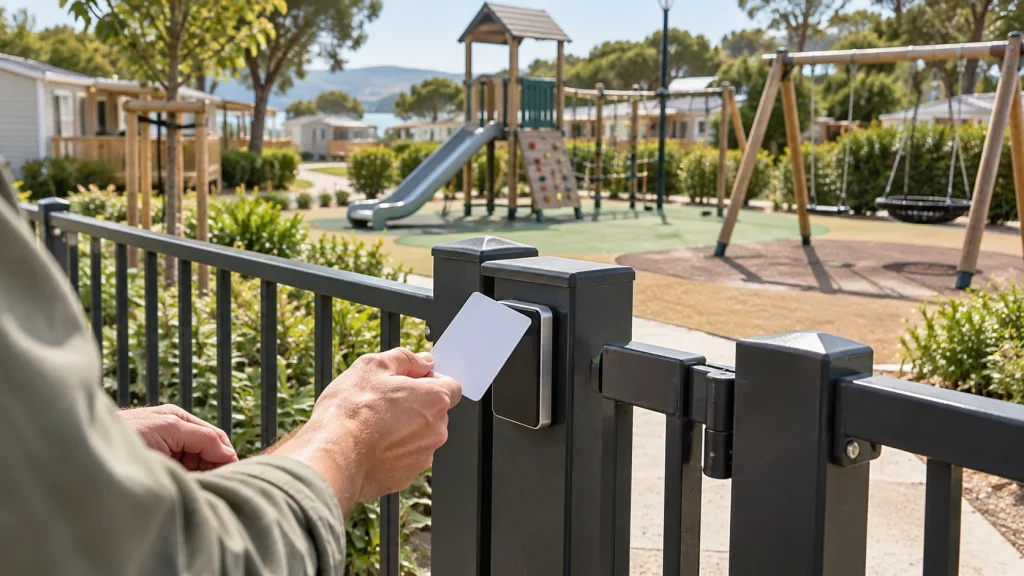
At the entrance, look for instructions on the door or reader. Some systems ask you to tap the card; others require you to hold it in place briefly. Watch for a light, sound, or display message, then try the handle normally. A door that does not open is not an invitation to pull harder. First make sure you are at the correct entrance and that the facility is open.
Note the building, door, and any message the reader shows, then contact the campsite staff through the contact method provided at check-in. Those details help them identify the problem without guessing.
Separate card problems from access rules
A failed attempt does not necessarily mean the card is faulty. The facility may be closed, the entrance may serve a different group of guests, or access may depend on a reservation. A laundry room, for example, may have different arrangements from the sanitary building next door.
Imagine a family planning dinner in a shared cooking area. Their card opens the nearby sanitary building but not the kitchen door. Rather than treating that as proof that the card is broken, they should check whether the cooking area has separate hours or access instructions. Knowing the difference helps them ask a precise question and adjust their meal plans if necessary.
The same care applies to facilities that are open without a card. An unlocked entrance does not establish that every activity inside is available at every hour. Read signs about use, supervision, or reservations where they are posted. Follow the information for that particular space instead of relying on how another part of the site works.
Plan around the facility you intend to use
The best time to check access is before a facility becomes urgent. If you expect to use a shared kitchen, find out where it is and whether it will be available when you want to cook. For laundry, check both access and the practical details you need for a wash, such as operating instructions and whether machines appear to be in use. Avoid leaving clothes or food unattended while you return to sort out a card issue.
For a playground visit, the relevant question may be whether a card is needed at all. Some campsites make their playground activities available to guests and visitors. Even where an activity is open to visitors, adults should still check any signs at the activity area and keep children appropriately supervised. Access to one activity should not be taken as permission to use every guest facility on the site.
If your group splits up, decide who will carry the card before anyone leaves. One person taking the only card to a distant activity can leave others unable to enter a building they need. Check with staff if you need another card or are unsure how your group should enter together; do not assume one card can be passed around freely under the site’s rules.
For more detailed information on this topic, read our guide on How to Choose the Right Caravan Pitch for a Comfortable Camping Stay.
When something does not match your booking
If the information you received says you should have access but the card does not work, report the issue while staff can still help you plan around it. Give them your accommodation or pitch details, the facility you tried to enter, and the time of the attempt. You can then ask whether the card needs checking, whether a different entrance applies, or whether the facility is temporarily unavailable.
Keep the card with you until the issue is resolved, and avoid borrowing another guest’s card. Their access may differ from yours, and sharing cards can make it harder to establish what went wrong. If a facility is unavailable, ask what options apply to your stay rather than assuming there is an alternative.
A useful access check is straightforward: confirm the facility’s rules, bring the right card, follow the reader’s instructions, and ask staff when the result conflicts with your booking information. Doing this early leaves more time for the reason you wanted to use the facility in the first place.